- All
- Manisha Panchakam
05 Manisha Panchakam Verse 5
In this final verse, this is further elaborated and also in response to the second question of the Stranger, where he indicated this very nature of the Atman.
04 Manisha Panchakam Verse 4
Is the ‘I’ consciousness applicable only to human-beings? Or is it true for all life-forms? Besides independent of the ‘I-consciousness’, the instruments such as the mind and the organs of perceptions are also seem to have their own local intelligence.

01 Manisha Panchakam Context
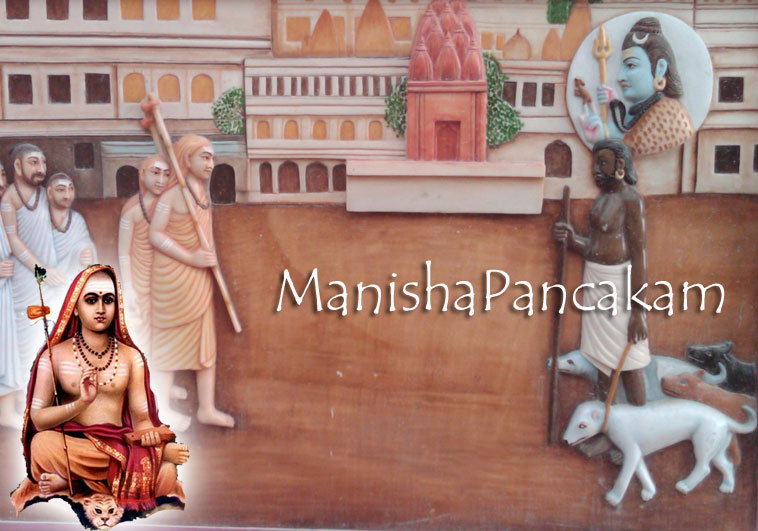
The Stranger, who was confronting Adi Sankara and his entourage in the narrow street of Varanasi, raises his questions when he was scornfully asked to get away from the path. His questions unearthed profound thoughts of Sankara in the form of Manisha Panchakam.

01 Introduction Manisha Panchakam
Adi Sankara’s ‘Manisha Panchakam’ refers to the conclusive wisdom or determinate knowledge asserted in five verses. What is Sankara’s assertion as his determinate knowledge? What is such conclusive wisdom? An impactful encounter in Bhagavatpadal’s life, resulted in this wonderful revelation.
Nirvana Shatakam
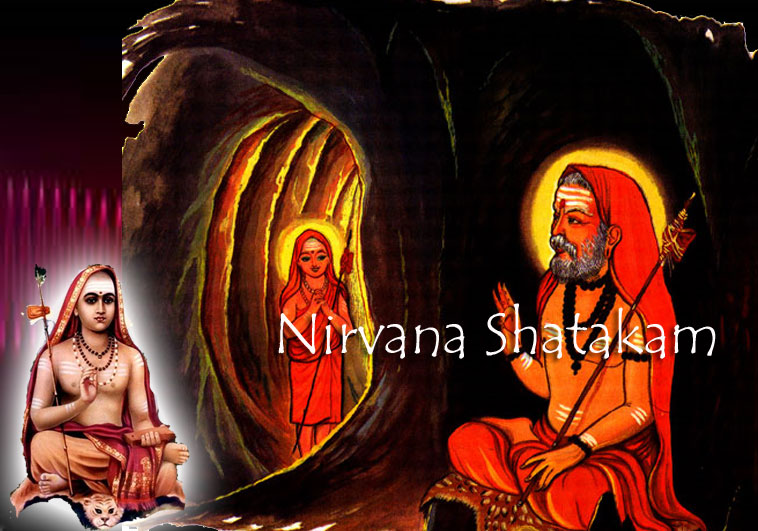
When Adi Sankara was a young child, he approached Guru Govindapaada for seeking guidance. When he was asked to introduce himself, the young Sankara offered in six verses the true nature of the Self.
03 Manisha Panchakam Verse 3
Adi Sankara, after explaining the identification and the unification of Jeevaatman and Ishvara in the first two verses, gives the instruction on the method by which such superior wisdom can be obtained and upon achieving, the need for unwavering commitment to that wisdom and to realize the ultimate benefit in this third verse.
02 Manisha Panchakam – Verse 2
In this second verse, the Paramaatman is analyzed and as it represents everything in the worlds, the experiences of the world are taken as the subject of analysis. It starts with the assumption that worlds are created by Ishvara. Why is this assumption valid?
01 Manisha Panchakam Verse 1
To understand the Self, the experiences of the Self are the most appropriate areas of study. In this verse, when analyzing the Jeevaatman, the human embodiment is viewed in terms of three bodies and the three experiences that these bodies are variably subjected to.
Every human-being variably suffers or endures three types of experiences of consciousness; the Upanisads define these experiences by the term ‘avasta’ and correlates these experiences to the different bodies.