40 – Nastika, Am I ?
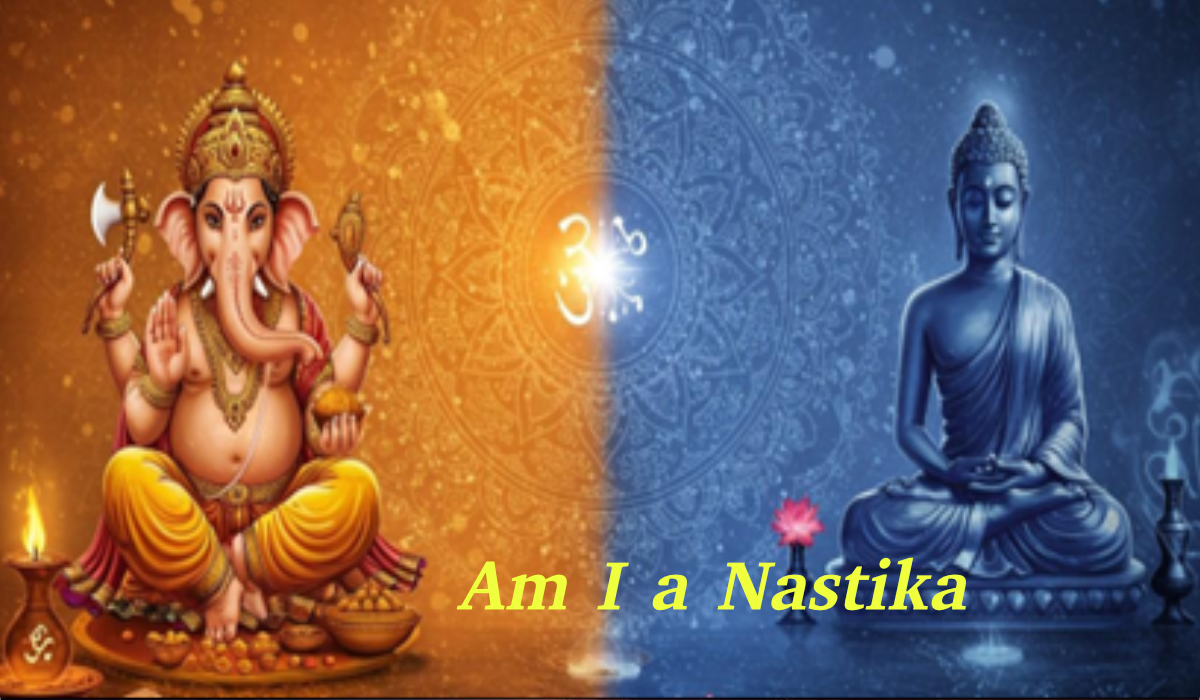
Am I Nāstika!
Conversation With Aiya (40)
After a long time, Bhaskar and Vasumathi had come. Bhaskar and I had worked together in a company many years ago. I was very happy to meet them both after almost fifteen years. That evening when they came and were with us, by chance, Ayya also came, brining more cheer.
After introducing Ayya and them to each other, I went to the kitchen, made a kind request for coffee with Uma, and came to the hall.
By then, an interesting conversation was going on there.
“I will go alone, Ayya! He will stay at the hotel” – Vasu was saying.
“Where are you talking about going, Vasu!” – I asked.
“Brother, just now, Ayya had asked me about our trip to India, did we go to any temples etc. That’s what I was telling. As you know, Bhaskar has nothing to do with temples and so I need to leave him in the hotel rooms while I visit the places.”
Vasu looked at me, saying without much emotion.
Vasu and Bhaskar got married because their love of each other; At the time of their marriage itself, although a gap seemed evident between them, yet their greater love for each other overweighed all. That gap related to their faith: Vasu is a strong believer in God, in performing worship, and rituals. Bhaskar, in his language, is a ‘proud nāstika’.
I smiled and sat next to Ayya.
Bhaskar said.
“I don’t need all these temples etc as I don’t believe in such things!”
Ayya said.
“That’s fine. Yet you are accompanying your wife and that is what is important!”
“Yes Ayya! Bhaskar is always like this! The doctrine of nāstikam is his favourite thing.” – Vasu said.
Bhaskar interrupted.
“Not doctrine; the truth of nāstikam!”
At that moment, Uma came to break the short silence that prevailed.
“Here, hot filter coffee. Ayya, here is some nice hot water for you!”
After giving it to everyone, she too sat there.
Bhaskar continued.
“I am not saying no to Vasu’s superstitions. Therefore, there is no problem between us!”
I intervened.
“Bhaskar, don’t call Vasu’s belief a superstition; perhaps say that she has somewhat different views than yours.”
“Ok, so be it! You are all the one calling me nāstika. As far as I am concerned, I tread only along the rational path.”
Ayya laughed.
He looked at Bhaskar closely and asked.
“Are you really a nāstika?”
“Yes, Ayya! What is the doubt about that!”
“Who is a nāstika?”
“In my view nāstika does not believe in what you believe – a God – be that a male, female, or anything! There is nothing like that!”
“Is this your intellectual conclusion?” – Ayya asked.
“Yes! A rational conclusion!”
“How do you say that?”
“Because no one has ever seen such a God, nor heard Him speak. This is all a superstition!”
Ayya replied.
“Perhaps! I too have not seen in a form with my own eyes.”
“Then what is the doubt, to say that there is no God!” – Bhasker said.
I was excited as a good discussion had just begun.
After a momentary pause, Ayya looked at Bhasker and asked.
“Is the cat here?”
Puzzled by that question, Bhaskar responded.
“What…. A cat? Where is it here! Definitely not!”
“It could be in the next house!”
“You can say that, Ayya! But one can say so for sure, only by going into the next house and check!”
“Then go and see.”
“How, Ayya! Can I easily go into the next house like that? What is this question?”
“Then, your answer to my question about its existence cannot be an assertive negation but a polite submission that it could be somewhere and you do not know.”
Bhaskar remained silent.
“So, in your view God is not here, does it confirm God exists nowhere! Only after you have analysed all the places, you could make such an assertion. Have you searched at all places at all times?”
“No, Ayya! I will say that it is not possible for me to say for sure that God exists.”
Then I injected
“Bhaskar, then you can’t say for sure that God doesn’t exist!”
“I agree. For me, I don’t know if God exists. That’s why I say with some assumption God does not exist.”
Ayya corrected.
“That means, since you can’t reason out that God doesn’t exist, you opted to state that God doesn’t exist on some kind of belief, right?”
“Ayya, maybe you can say that. I have a right to that belief!”
“Absolutely! Similarly, Vasu also has a right to believe that God exists, right? Well, we’re not talking about the rights here, but about its reasoning. A belief that is derived because there is no intelligent reason, then it is a superstition. So, your argument that God doesn’t exist is superstition.”
“Isn’t the belief that God exists also superstition?”
“No! Because that belief doesn’t require any knowledge! Does a child examine the reasons to identify with its mother! It is an intuitive feeling, an unawareness beyond intellectual scrutiny. Such a belief, is not a superstition, but a pursuit to realization!”
I looked at Vasu; her face was glowing in joy.
Bhaskar said.
“Okay Ayya! Let’s leave God alone. God is not the only reason why I am a nāstika! Based on the superstitions, all your Vedas’ foster stupidity! That is what many people, starting with Buddha, opposed! So, you may consider a nāstika as a rejecter of Vedas. That definition, I can concur with!”
“Well, in that case, have you studied the Vedas properly?”
“No!”
“How can you criticize the text without studying it?”
“No need for me to study, Ayya! The rituals performed in the name of the Vedas, the caste and religious differences that spring from these customs – all these are social injustices! Therefore, I reject Vedas, as those are the cause of the social injustice.”
Ayya laughed.
“Social injustice should be eliminated wherever it is. If there is no Dharma, then there is no world worthy of existence. So, I also understand the impact of what you are saying. But you have forgotten the higher truth.”
“What, Ayya?”
“A surgeon’s sharp knife is necessary for discharging his caring duties. But if that instrument is taken by a fool to harm others, who is to be punished? Is the medical instrument? the one who does not protect it properly! Or the one who uses it improperly?”
“Ayya! I do not want to go into this argument! I cannot read the Vedas! I do not need it!”
“Don’t read. Don’t understand! That is your choice. But then how can you call something that you have not tried to understand evil? Therefore, rejection of the Vedas cannot be the remit of a nāstika either!”
Bhaskar laughed.
“Ayya! This word nāstika was coined on us, only by those who studied the Vedas. It was them who called the followers of Buddhism, for example, as nāstika!”
“That is true! Those disciples who did not understand the truth of what venerable Buddha had stood for, and ultimately turned His teachings into a religion of rejection of the Vedas, were called ‘nāstika’. If you are such a ‘nāstika’, then it is expected of you to first understand the true teachings of Buddha and how it was distorted by the followers. Then you can choose to remain as nāstika.”
Bhasker forcefully replied.
“Ayya! Buddha rejected the Vedic rituals. He rejected the Vedas totally and told us to live only for the benefit of society through love and service.”
Ayya laughed again.
“Of course! We should all accept the teachings of the venerable Buddha wholeheartedly. That is why those who live according to the Vedas also accept venerable Buddha as an incarnation of God. That is not the problem!”
“Then What?” – I interrupted eagerly.
“Before Buddha, there was no such thing as ‘Buddhism’. All the religions that existed at that time were based on the Vedas, but of varied interpretations and practices. There was a time many, without properly understanding the truth of the Vedas, exaggerated the rituals and the benefits therein, as the sole purpose of Vedas. Just as a drunkard took away the surgeon’s knife, these misled scholars, who exaggerated the Vedic rituals at the cost of ignoring the true import of Vedas, led to division and become the cause of heinous atrocities such as sacrificing lives in the name of rites. It was then that the venerable Buddha, who blossomed in superior wisdom at the trigger of realization about the impermanence of life, and the inevitability of ageing, disease and death, showed a path to unite the divided society with love.”
“Exactly, Ayya! That is what we should accept, is it not!”
“Of course, yes! But then, should we also accept things that the venerable Buddha never said?”
“What do you mean?”
“In the name of venerable Buddha, misreading His silence of eloquence, the followers had created a path called Buddhism that hates and disregards the Vedas! These we do not have to accept without scrutiny!”
“Ayya – You said it yourself! Buddha said to stop all Vedic rituals!” – Bhaskar asked.
Ayya smiled.
“Yes! Understand! What would a responsible teacher do if he entered a class – and there was chaos, with all the students shouting loudly, arguing, everyone reading some books, loudly and ruining the whole ambience of study”
We all listened quietly.
“That responsible teacher will immediately tell everyone to stop whatever they are doing! He will say, ‘Close all your books immediately. Don’t read anything. Sit quietly. No one will fight with each other, sit in rows! Respect others! Until you have shown peace and discipline, I will not take classes. Isn’t that, right?”
“Yes, Ayya!”
“That’s what the venerable Buddha did. He simply listed some social ethics and qualities for the people to follow as they were not ready to understand the true import of Vedas, and sat in meditation for a long time. His disciples – remember – most of the venerable Buddha’s disciples were only the people who had previously practiced the Vedas – turned their teachers silence into a denial of the Vedas; thus, after the times of venerable Buddha, they turned their doctrine into Buddhism.”
Ayya continued: “Understand – in the example I gave, did the teacher ask the students to close their books to mean that there is no need to study anymore – Or – was he intending a short-term ban for things to get right?”
“Ayya, are you saying nāstika are not those who reject Vedas”
“No. I did not mean that. I only laboured the point for you to ponder on this. Listen, everything that is done for social justice is noble! We should all do it. But saying – nāstikam has the exclusive license for social justice – is utter nonsense!”
“Ayya! Then why did people like Adi Shankara argue against Buddhism?” – I asked.
“Bhagavan Shankara worked not only against Buddhism, but also against many other religions that were once appeared to be more than 72 in numbers. Rather than against, Bhagavan worked to reconcile them! That topic is a different matter. What you need to know is that it is wrong to say that those who fight against social injustice are only the nāstika. All those who work for social justice are good people. That is the idea.”
“Ayya, what is the reason then that Buddhism is deemed as the religion of nāstika?” – Vasu asked.
Ayya sighed with a relief.
“I was waiting for this question. Are you ready to listen patiently?”
Bhaskar interrupted.
“Of course, Ayya! It doesn’t matter whether I am a nāstika or not. Social justice is important. If the Vedas dictate actions that cause social justice in the name of God, then it should be changed. That is my desire.”
“Great! This cannot be resolved here. It is because in the great forest of the Vedas, it is wrong to lose the enchanting rose by saying that there is a thorn in some places. Everything has a role to play and this has to be understood. Therefore, we will learn properly, investigate and decide about it. For that purpose, one does not need to hold the identity of nāstika!”
“Then should I become an āstika?” – Bhasker asked.
Ayya laughed again and spoke!
“Why do we prioritize only a few words that too without any understanding of those words, and get stuck in it. We have just discussed that the word nāstika or its identification is unnecessary to seek truth and do good things. You immediately jump to another word – āstika!”
“Then how! Is not āstika the opposite of nāstika? I know, āstikas are the ones who trust in God, the Vedas, and rituals!”
“It may be! That does not mean, if you are not nāstika, you somehow become āstika.”
“Why not? Is there something else between the two?”
“Unless and until we understand the clear differences between these terms, we remain as are ordinary people. Let’s be just ordinary people and in that context, understand who an āstika is, and then choose whoever we want to be: an nāstika or a nāstika.”
“Okay.”
A couple of minutes passed in silence.
Ayya continued.
“Let’s leave out God. We haven’t seen God yet in our limited understanding of Him. Let’s also leave out the Vedas. We haven’t read the text and understood yet. That means, we only have the World and our own self to deal with. The world is our platform of life. So, we need to know it and then about ourselves. That’s it!”
We all nodded yes.
“Although we strive every day to understand the world, we cannot understand it completely as it is constantly changing. We soon learn to adapt to it. Isn’t it?”
No one said anything.
“Then the only thing we need to know is who we really are.”
“Ayya! What’s new in this? We all know about ourselves, right?”
“Perhaps, not everyone who followed the venerable Buddha knew that exactly?”
“What do you mean, Ayya?”
“I’m asking you directly. Do you exist?”
“What is this question? I am right in front of your eyes, Ayya!”
“Oh, that helps! Suppose you were alone in a dark room, and I couldn’t see you, should I conclude that you don’t exist!”
“Whether you know or don’t know, and whatever you say about my existence, I exist and I know!”
“Surely?”
“What is this question, Ayya! One knows about one’s own existence without a need for any instrument!”
“Why! Is it because you can see your own body?”
“Not at all! Without seeing the body, I know that I am! Even if my body changes from a small child to an adult, I know that all those forms are only I. Where do I need to go and study for this?”
“Good! Do you know that you exist when you are deeply asleep?”
“I don’t know then, as my mind is also asleep! But after waking up, I know that I have slept.”
“So, your existence is beyond your embodiment, right?”
“That’s right, Ayya! I’ve never thought about it like that before.”
“Now think about it! Beyond your waking, dreaming, and sleeping states, feel that you exist.”
“I’m thinking about it, Ayya!”
Ayya laughed.
“Do you know what the disciples of venerable Buddha concluded after contemplating about the existence?”
“I don’t know!”
“They concluded that there is nothing! They decided that there is no ‘I’ – the Self – resolves in to nothingness or shunyam. They have even developed a fascinating doctrine called ‘Shunya Vada’. Look at the irony, you are asked to Live well and finally end up into nothingness. All the endeavour of love, virtue for social justice just to become nothing. What strange goal to aspire for!”
“Ayya, is that nothingness means to state that there is nothing after death?”
“No! There is no such nonsense in Buddhism as it deeply examines the cycle of birth as ‘samsara’, and correctly states that the cause of it is desire, and suggests the means of harmonious living without undue desires to cut asunder the cycle of birth and death. But strangely, only to be resolved into emptiness! How can that be correct? Although the later generation of Buddhists changed it a little and assigned a momentary status of existence to the Self – by the doctrine of kshanika-vada. That’s also incomplete and full of misapprehension.”
Ayya continued.
“This is the truth of the Vedas. Each of us is an unchanging, immortal light, a consciousness called ‘Atma’. In fact, the import of Veda is the assertion: Existence is Atma. In Sanskrit, ‘asti’ means ‘existence’. The reasoned belief on ‘asti’ makes one as the āstika. If you believe, nay, if you know and can say ‘I exist’ then you are, you like it or not, an āstika.”
“Are we rejecting the Buddhist doctrine of emptiness as false?”
“Shūnyam means nothing. If nothing exists, then it is ‘asti’. Let us not play with words. Who perceives that there is only nothingness! Only if there is a perceiver of nothingness, such a declaration could be made!”
“Yes!”
“That means, the end is not the emptiness, but the seer of that so called emptiness! That is the Atma. That is perfection! Atma is not emptiness but fullness! Paripurnam! That is, You! That is me. The journey to attain the realization is ….”
“Āstikam” – I interrupted!
“Maybe. What I meant to say is that the journey to attain the realization is our very human-life. The precious dwelling in this embodiment is only for that perfection.”
I looked at Bhaskar.
He had many questions in his mind, but there was a glow of joy. Surely, he would have found an answer to his own question ‘Am I an nāstika?’
I too have a question raising in my heart: Am I an āstika?
I should ask Ayya this.
Vasu and Bhaskar gently stood up and bowed to Ayya. Uma and I followed suite1 Isn’t it a great honour to pay obeisance to the teachers!
Mee. Rajagopalan
02-Jan-2026